Alberta and Great Waterways Railway
Second Edition – April 2026 – Compiled by Gerry Dubé
The 1909 Charter
- In February 1909, the Government of Alberta granted a charter to the Alberta and Great Waterways Railway Company (A&GWR). The company was owned by William R Clarke and Bertrand R Clarke of Kansas City, Missouri, and William Bain of Winnipeg.
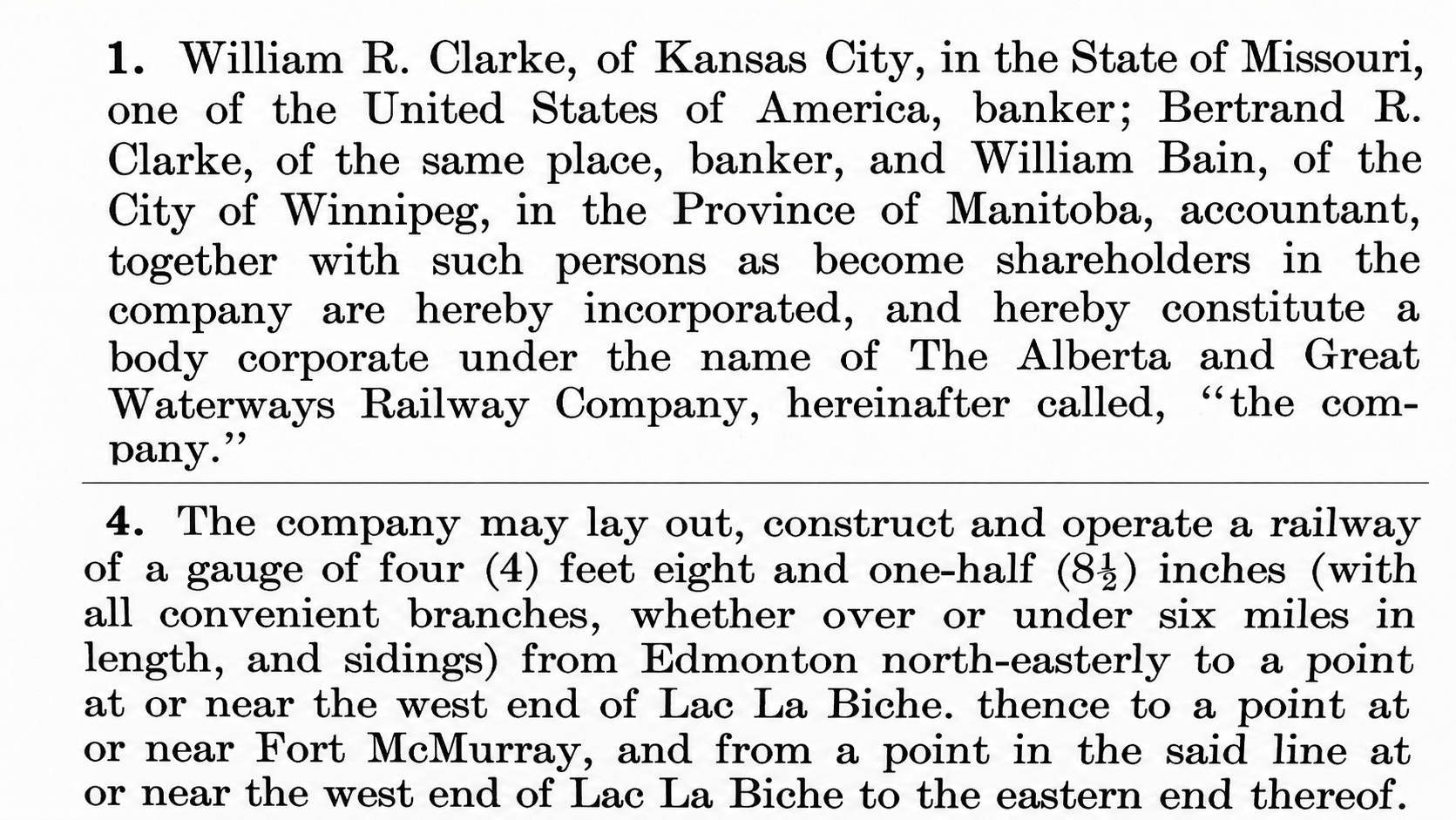
- The charter authorized the construction of a railway from Edmonton northeasterly to a point at or near the west end of Lac La Biche then proceed to a point at or near Fort McMurray.
- The goal was to open northern Alberta for settlement, resource development and transportation access.
- November, 1909 – First Sod turning ceremony
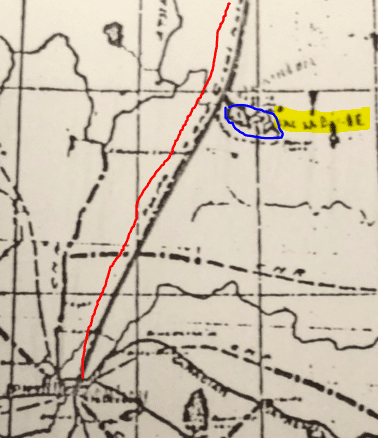
In the map, one can see the proposed route leaving Edmonton, and heading north travelling on the west side of Lac La Biche Lake, which is circled in blue. The yellow section, highlights the words: Lac La Biche
Financial Terms (Key Issue)
- The Government of Alberta guaranteed loans / bonds per mile of track to encourage the construction of the proposed railway.
- The financial deal for the Alberta and Great Waterways Railway Company was unusually generous at a guaranteed rate of $20,000 per mile of track.
- The Alberta and Great Waterways Railway agreement consisted of 350 miles of railway to be built at $20,0000 per mile plus $400,000 for the Edmonton Terminal, for a grand total of $7.4 Millon.
- The A&GWR entire issue of bonds was sold to J.S. Morgan and Company of New York and then resold on the London Stock Exchange for $7.4 million on November 1, 1909 for allegedly at par value. Shortly afterwards, it was learned that the bonds had been sold at 110 percent instead of the par value of $7.4 million. The $740,000 difference was never satisfactorily explained.
The Scandal (1910)
- When details of the London resale become public, a major political scandal erupted with allegations of over pricing, favouritism and concerns that the railway was of a speculative nature rather than a practical investment.
- February 1910 – Provincial Leader of the Opposition Conservative Party R.B. Bennett and Liberal back bencher John R Doyle, MLA for the Electoral District of Sturgeon (which included Plamondonville) raised several questions about the A&GWR contract including constructions standards, government supervision of standards and financing.
- February 1910 – W.H. Cushing, Minister for Public Works, resigns from his cabinet position.
- March 1910 – Premier A.C. Rutherford announces intention to appoint a royal commission.
- May 26, 1910 – Lieutenant Governor Bulyea announces the resignation of A.C. Rutherford as Premier and asks Arthur L. Sifton to form a government.
- December, 1910 – Alberta Legislature passed a bill allowing the A&GWR bond money in the banks to be transferred into the provincial treasury and then used for other public works.
- 1911 – Banks appealed to the British Privy Council on the legitimacy of the 1910 Act.
- A government inquiry found no outright corruption by Premier A.C. Rutherford, yet showed poor judgment in approving the A&GWR contract.
- For more information, one can download a 172-page PDF file. It is 1990 Master’s thesis by Jay Steward Heard: “The Alberta and Great Waterways Railway Dispute 1909 -1913”. The download link is at the bottom of the webpage: https://ualberta.scholaris.ca/items/8589c35b-c603-4005-8e68-87aecdc11bce/full.
The Aftermath of the Charter (1913)
- The original charter to William R Clarke and Bertrand R Clarke effectively collapsed by 1913.
- 1913 – British Privy Council ruled in favor of the Banks. It found that the Alberta Legislature did not have the authority to confiscate money that had been raised from investors from outside the province.
- September 1913 – The Government of Alberta reached an agreement with John Duncan McArthur to take over the Alberta and Great Waterways Railway Company. McArthur submitted a route map to the Department of Railways and Telephones that described the railway line passing through Lac La Biche at the east end of the lake as per the map below.
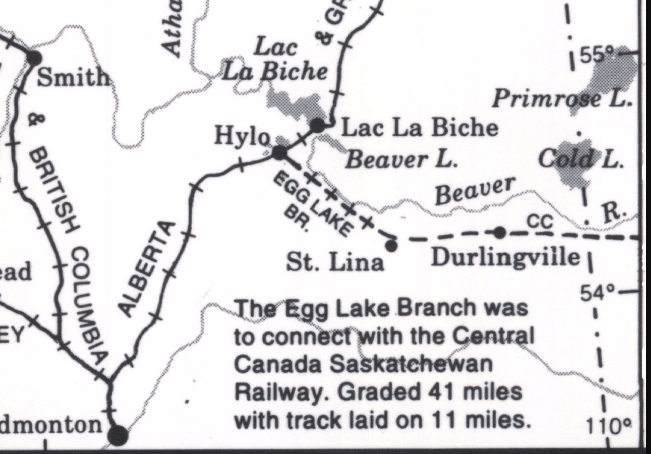
- In 1915, the charter appears to have been amended in section 4, as per below, to strike out the words, “the west end of”, relative to Lac La Biche Lake, leaving it wide open for John Duncan McArthur to build the rail on the east side of the lake.

- The Alberta and Great Waterways Railway reached Lac La Biche townsite on February 4, 1915 and finally reached Waterways (by Fort McMurray) in 1925.
The Involvement and Impact on Plamondon Settlers (1909 - 1913)
- There was huge excitement when the A&GWR survey party arrived in the Plamondon area in the fall of 1909.
Around the same time, Mathilde (spouse of Joseph Plamondon and Dellamen’s mother) wrote to her daughter Isabel, “There is strong speaking about passing the railroad around here … They say it will pass at Isadore and our farm. If it does, I tell you those places will be worth something for there is such nice farms. I wish Simon Hahnenberg and you would see them, but we must wait for the train to come first before seeing each other.”
Mathilde
Dellamen (the eldest daughter of Joseph Plamondon) wrote to her sister, Isabel, who lived in Michigan USA, "There is strong speaking about passing the railroad around here … They say it will pass at Isadore and our farm. If it does, I tell you those places will be worth something for there is such nice farms."
Dellamen
Testimony from André Ménard: “In the early 1900s, sometime after 1908, my grandfather, Emilien Ménard, wanted to farm. He was originally from Québec and was residing in St-Albert. Somehow, he became aware of Plamondon. He acquired the south half of Section 3 - TWP 67, RG 16, W4M, via a relatively unknown piece of Canadian Legislation: The Volunteer Bounty Act of 1908 (https://electricscotland.com/history/canada/alberta/vol1chap12.htm - Scroll down to: MILITARY BOUNTY LAND SCRIP). The Act granted 320 acres of free homestead land in Western Canada, to Canadian soldiers who had served with the British forces in South Africa, during the Boer War of 1899-1902. The Act also enabled soldiers to name a substitute applicant/owner, if they didn’t want the land.
On October 13, 1908, the aforementioned 320 acres (2 quarters) were originally assigned to Ajutor Asselin from Montréal, Québec, under the auspices of The Volunteer Bounty Act of 1908. When he cancelled his ownership, Emilien Ménard was appointed the substitute on August 14, 1909, by the Department of Interior, and obtained entry to the homestead on June 15, 1910. In addition, he purchased a homestead in the NE of Section 3 - TWP 67, RG 16, W4M gaining entry on July 6, 1914. To help preserve the history of the original route of the Alberta and Great Waterways Railway, my grandfather would often say that in the fall of 1909, crews surveyed the proposed right of way through the east half of Section 3-Twp 67-Rg 16-W4M, land that he would eventually control.”André Ménard
- On February 9, 1912, the Edmonton Daily Bulletin reported on claims made in A&GWR’s case as presented by Premier Sifton:
- Joseph Plamondon – for goods supplied and services rendered as blacksmith and carriage maker between April to July 1910 ..… $260.
- Évangelist Plamondon – for tent sold to survey party: $10; rent of wagon to survey party: $15 ….. $25.
- Ernest Plamondon – for wages as caretaker of supplies, October 11, 1910 to February 24, 1911 at $35 per month ..… $155.15. Note: This entailed guarding the 3 food caches north of Plamondon.
- Levi (Oliva) St-John – for wages as caretaker of supplies, August 1, 1910 to February 24, 1911 ….. $258.10. Note: This entailed guarding the 3 food caches north of Plamondon.
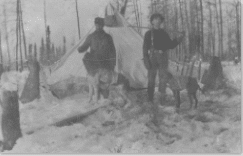
- March – April, 1911 – Plamondon settlers and First Nations people are mobilized hastily, to salvage the 6 abandoned food caches that were established in late 1910 by A&GWR, to supply the survey crews as they progressed north toward Fort McMurray.
Testimony of Germain Labonté (area resident) in a 1981 audio interview: “My parents, Joseph Labonté and Sophronie Labonté (née Gagnon) emigrated from Michigan to Plamondon in March 1910. My seven siblings and I were also part of this journey. We ranged in ages from 18 months to 16 years old.
During the late summer of 1910, the A&GWR had established 6 food caches toward Fort McMurray. The furthest cache we knew about was 10 miles north of la Rivière des Montagnes (known today as House River). We knew this because Oliva St Jean and Ernest Plamondon had been hired to guard the caches.
In late February 1911, for reasons unknown to us, the A&GWR terminated the employment of Oliva and Ernest leaving the food caches unguarded and unprotected. We heard about the Charboneau family salvaging one of the less distant food caches, yielding so many goods that could not all be stored inside the cabin and had to be stored outside in a tent.
That peaked my father’s interest because we were so poor. So, my father got together with Narcisse St Jean (brother of Oliva) to hatch a plan to salvage the two most northerly caches - one at House River (approximately 80 miles) and north of House River (approximately 90 miles). Narcisse had an inside line on the location of these 2 caches because he had accompanied Oliva earlier to help relieve the days of boredom guarding the caches.
So, they left sometime in March 1911, with a team of oxen and a sleigh. In two feet of snow, travel was slow at maybe 2 miles per hour. They finally arrived at the cache at House River to discover it was severely compromised by salvagers and wildlife damage. So, they decided that Narcisse will walk (10 miles) to the furthest cache to confirm its integrity. My father would follow his tracks with the team of oxen and make camp at dark to wait for Narcisse to return.
Sure enough, Narcisse returned in the middle of the night using a candle for light. He reported that the cache was intact and there were way more supplies that one sleigh could handle. So, they decided to return to the cache at House River and that my father will stage there with the team of oxen. There was a small stable there with a supply of oats and hay.
Narcisse would walk to Plamondon, 80 miles in 2 days and return on Day 8 with a second team of oxen and another sleigh. If Narcisse had not returned by Day 8, then my father would proceed on Day 9 to salvage all he could with the one sleigh.
Sure enough, Narcisse arrived on Day 8 with a second team of oxen. They proceeded to the cache with the two teams to salvage all that they could. Merchandise included flour, sugar, dried beans, macaroni, dehydrated fruit and boxes of candles. They also discovered that First Nations from Pelican Portage had discovered the tracks of Narcisse leading to the cache and they had begun to salvage supplies.
I was five years old when my father arrived in the middle of the night. I remember because it created such huge excitement.”Germain Labonté
Testimony of Madame Octave Chevigny (Dellamen, the eldest daughter of Joseph Plamondon) in 1958: “Le tracé du chemin de fer qui fut arpenté vers ce temp -la, amene beaucoup de va-et-vient entre Plamondon, Wandering River et House River jusqu’à McMurray. Des caches avaient été bâties ici et là avec les provisions necessaires pour la construction mais l’espoir de ce chemin de fer tant attendu ne fait jamais réalisé. On dit que l’argent parle; eh bien c’est ce qui arriva dans ce cas. Le chemin de fer prit une autre direction, et les gens restèrent le bec a l’eau (mais peut-être pas pour toujour).”
Madame Octave Chevigny
Translation: “The planned railway route, which was surveyed around that time, involved a great deal of back and forth between Plamondon, Wandering River, and House River as far as McMurray. Caches had been built here and there with the necessary supplies for the construction, but the long-awaited railway was never realized. They say money talks; well, that’s what happened in this case. The railway took another direction, and the people were left high and dry (but perhaps not forever).”
Testimony of Emile Plamondon (area resident) in 1982: “The economy in the years 1912-14 was quite good. The Government of Alberta, still in its infancy, backed the A&GWR to build a railroad from Edmonton to Fort McMurray. The survey for the right of way, passed one and a half miles from Plamondon, through what later became known as the Avenir district, about fifteen miles north of Plamondon and at the east end of the Wandering River and the Breynat districts.
It would have served plenty of good farming country, but through the manipulation of a very rich man, Mr. John McArthur, the plans were changed. One main reason was that he owned substantial tracts of timber in the area that is now known as Venice and Hylo, extending south west up to the Heart Lake district. Also covering an area, north east of what later became the townsite of Lac La Biche. The railway was detoured to cover territory at a cost of sixty more miles to reach Fort McMurray. Mr. John McArthur built a huge hotel within the townsite, hoping to attract tourists to the area.”Emile Plamondon
Conclusion
- Plamondon residents appeared to have a weak connection to the events that happened in Edmonton during the years of 1909 -1913.
- The exceedingly generous financial terms.
- The unaccounted $740,000.
- The resignation of Minister W.H. Cushing.
- The resignation of Premier A.C. Rutherford.
- The cancellation of the railway contract with the Clarke Brothers.
- Notwithstanding these events, the Clarke Brothers would have built the railway along the intended right of way west of Lac La Biche.
- By 1913, the Liberal Party of Alberta had expended considerable political capital on the construction of the Alberta and Great Waterways Railway. So, when John Duncan McArthur, an experienced railroad builder, appeared ready to take over the contract, Premier Sifton smiled on his luck. As they say, “the rest is history”.
References
- * Plamondon Historic Book Society. From Spruce Trees to Wheatfields. 1988.
- ** Johnson, Gregory A. et all. Lac La Biche Chronicles: The Early Years. Joint Project by Portage College and the Town of Lac La Biche, 1999.
- “An Act to Incorporate The Alberta and Great Waterways Railway Company, SA 1909, c 46”, CanLII, Canadian Legal Information Institute, Accessed 18 Mar, 2016, https://www.canlii.org/en/ab/laws/astat/sa-1909-c-46/latest/sa-1909-c-46.html.
- Provincial Alberta Archives: PR1973.0324/68 (1909 Chapter 46 – An Act to Incorporate the Alberta and Great Waterways Railway Company – Assented to Feb 25, 1909) – Shows where “the west end of” was struck out in 2 places.
- “The Central Canada Railway.” Atlas of Alberta Railways. University of Alberta Press, 2005, https://epe.lac-bac.gc.ca/100/205/300/atlas_of_alberta_railways/06-02-07/railways-atlas.tapor.ualberta.ca/cocoon/atlas/Chapters-11-4/default.htm?nodisclaimer=1.
- “Alberta & Great Waterways Railway Scandal.” Wikipedia. 20 October 2025. https://en.wikipedia.org/wiki/Alberta_and_Great_Waterways_Railway_scandal.
- Schneider, Ena. Ribbons of Steel: The Story of the Northern Alberta Railways. Detselig Enterprises, 1989.
- Maccagno, Tom. “The Plamondon Canal.” Alberta History, vol. 60, no. 1, winter 2012, pp. 19+. Gale Academic OneFile, link.gale.com/apps/doc/A281112371/AONE?u=anon~b3d0e3f1&sid=googleScholar&xid=0993ea2b. Accessed 19 Apr. 2026.
- * Chevigny, Dellamen, née Plamondon. Golden Jubilee (Histoire de Plamondon) 1908-1958. 1958.
- Chevigny, Dellamen, née Plamondon. Personal letters located at the Plamondon and District Museum.
- Dubé, Gerry. Personal Conversation with André Ménard, grandson of Emilien Ménard. 19, May, 2026.
- Ménard, André. Personal records relating to east half of Section 3, Twp 67, Rge 16, W4M.
- “Projet Héritage Franco-Albertain – Plamondon & District Interviews.” University of Alberta – Aviary (Audio/Video) Platform, University of Alberta, June 2024, https://ualberta.aviaryplatform.com/playlists/427/show/playlist_resource_id/10380/collection_resource_file_id/132001. Scroll down to: Entrevue avec Germain Labonté. This audio interview was recorded in 1981. Click on Part 2 (2/2) and move scroll bar to timestamp: 29:18. This story plays to timestamp: 49:27. The above link is found on the Plamondon and District Museum’s Digital Library: https://plamondonmuseum.ca/digital-library/university-of-alberta-archives-plamondon-district-pioneer-interviews/. There are appr 45 audio interviews with Plamondon’s pioneers.
- * L’Heureux, Aline and Emilie Chevigny and Zea Piquette. Joseph and Mathilda Plamondon Family 1884-1982: Emile Plamondon. 1982.
- Acknowledgement: Céleste and John Zurbrigg for research assistance.
* – These books are found on the Plamondon and District Museum’s Digital Library. The following link points to the University of Calgary’s Digital Portal. In their Local Histories section, they have kindly accepted to store our 18+ digitized Plamondon History Books:https://plamondonmuseum.ca/digital-library/university-of-calgary-digital-collections/.
** – These resources are found on the Plamondon and District Museum’s Digital Library. The following link points to 20+ historical books/articles/webpages in other areas of the Lac La Biche County and further out. https://plamondonmuseum.ca/digital-library/other-northeastern-alberta-history-digitized-resources/.