
Northeast Alberta Historic Trails Map
First Edition – Apr 9, 2026 – Compiled by Gerry Dubé
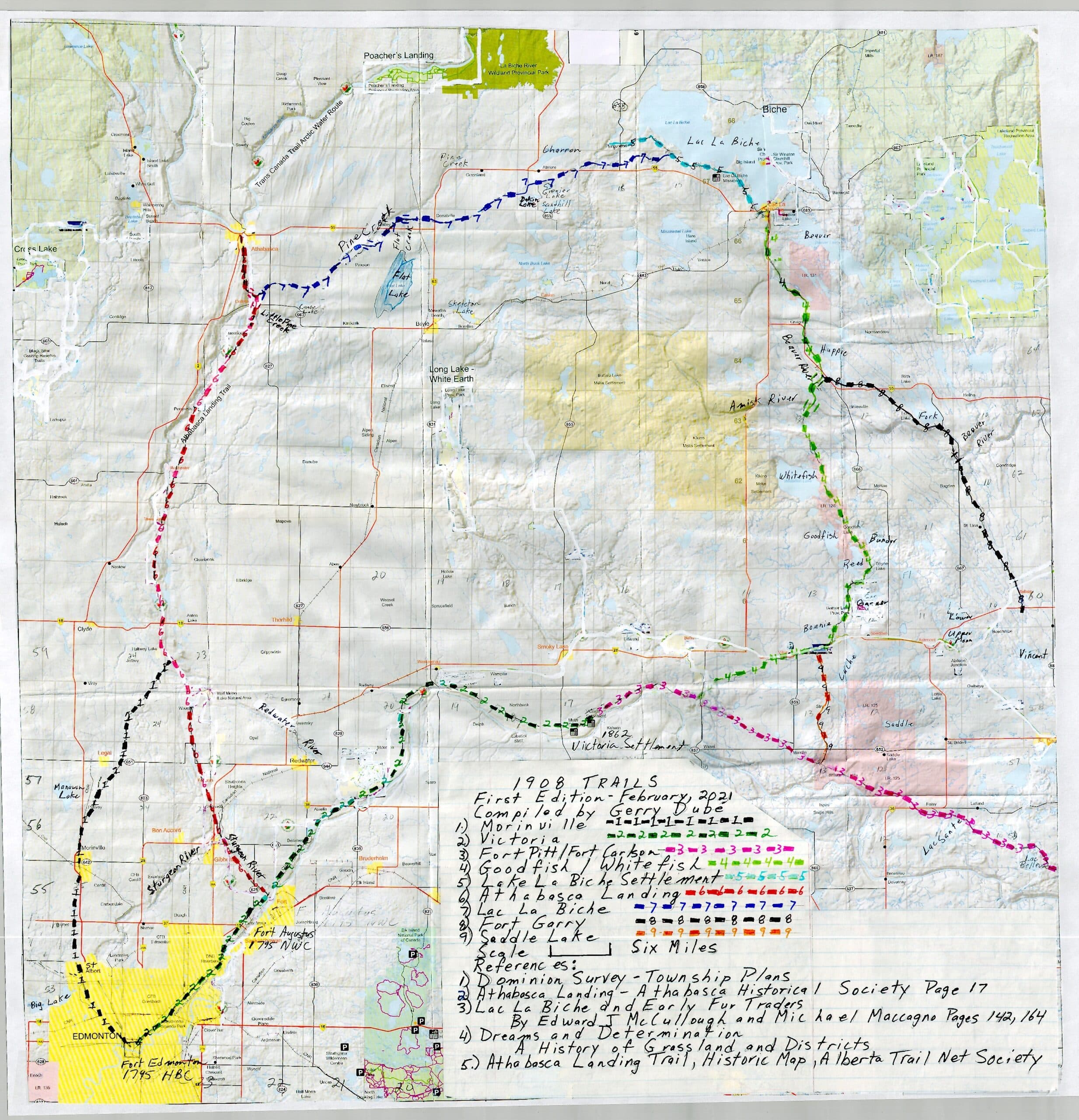
The 1908 Trails Map below, helps to illustrate the six trails that existed during the era, in which occurred, five major waves of Francophone settlers to Plamondon. They came from Québec, USA and France, arriving in various modes of transportation over several years.
Please refer to the legend area below, in the bottom right of the map, to observe the trail colors with the small associated trail numbers. Then follow the trail lines on the map. These are:
1 Morinville
2 Victoria
4 Goodfish/Whitefish
5 Lake La Biche Settlement
6 Athabasca Landing
7 Lac La Biche
Three additional trails used by the First Nations and Fur Traders are listed:
3 Fort Pitt/Fort Carlton
8 Fort Garry
9 Saddle Lake
The following, summarizes which trails were used, for each migration wave. Clicking on each wave will bring you to a detail page, listing settlers’ names. Plamondon has many family/community books (https://plamondonmuseum.ca/digital-library/university-of-calgary-digital-collections/) describing when their ancestors arrived in Plamondon. However, this is the only place where you will find all the names for each wave.
1st Wave: 1908, Jul 16-28: Wagon Trek – Michigan Migration (1st Wave)
This group arrived in Morinville by train on May 13, 1908. At this time Morinville was the furthest north by rail from Edmonton.
On July 16, it is highly suspected that the oxen/horses/wagons caravan headed east from Morinville on an existing trail, to the northern elbow of the Sturgeon River, to connect with the Athabasca Landing Trail. (This trail was built in 1876 by the Hudson’s Bay Company to improve transportation of goods between Edmonton and Northern Communities.) Note: No documentary evidence could be found for the aforementioned trail, therefore it is not recorded on the 1908 Trails Map.
From this point, the caravan travelled south on the Athabasca Landing Trail 6, to Fort Saskatchewan, to hook up with the Victoria Trail 2, heading east past Victoria Settlement. The caravan then headed north on the Goodfish/Whitefish Trail 4, to Lac La Biche. From this point, they travelled west on the Lake La Biche Settlement Trail 5, to the Lac La Biche Mission and eventually to Plamondon Creek, arriving on July 28.
In total, they travelled 150 miles, averaging 12 miles per day.
2nd Wave: 1908, Oct 7-17: Wagon Trek – Michigan Migration (2nd Wave)
On October 7, 1908, this horses/wagons caravan travelled north from Morinville on the Morinville Trail 1, to hook up with the Athabasca Landing Trail 6, to the town of Athabasca. From this point, it is suspected that they travelled east to hook up with the Lac La Biche Trail 7, north of Flat Lake. Note: This alleged existing trail is undocumented, therefore it is not recorded on the 1908 Trails Map.
The caravan travelled east to the village of Plamondon, arriving on October 17.
In total, they travelled 115 miles, averaging 10.5 miles per day.
3rd Wave: 1910, Mar 10-20: Sleigh Trek – Michigan Migration (3rd Wave)
The 3rd Wave arrived by train to Edmonton on March 5, 1910. On March 10, the caravan consisting of four sleighs pulled by their team of horses, departed Edmonton and headed north on the Morinville Trail 1, to hook up with the Athabasca Landing Trail 6. At the town of Colinton, the sleigh trek headed east on the Lac La Biche Trail 7, arriving in Plamondon on March 20.
In total, they travelled 115 miles, averaging 10.5 miles per day.
4th Wave: 1914, Spring: Wagon Trek – Brittany, France Migration (4th Wave)
This group arrived by train to Athabasca in the spring of 1914. By then, the rail line had reached this area. Shortly after, the small caravan travelled by horses and wagons eastward, likely using the same undocumented trail as mentioned in the 2nd Wave. They hooked up with the Lac La Biche Trail 7, eventually arriving to what became Gourin on April 11, five miles east of Plamondon.
In total, they travelled 32 miles.
5th Wave: 1916, May-Aug: Wagon Trek – Québec Migration (5th Wave)
By this time, Lac La Biche was linked by rail. Thus, this group arriving by train in May 1916, had the shortest trek to their homesteads. They travelled west by horses and wagons on existing trails to Berny, located about 7 miles south of Plamondon.
In total, they travelled 12 miles.
References
- Dominion Survey – Township Plans. “SPIN (Spatial Information System).” Service Alberta Government Registries, 2002-2026, https://alta.registries.gov.ab.ca/spinii/logon.aspx
- Athabasca Historical Society. Athabasca Landing: An Illustrated History. 1986 (Page 17)
- McCullough, Edward J, and Michael Maccagno. Lac La Biche and the Early Fur Traders. Canadian Circumpolar Institute, and Alberta Vocational College-Lac La Biche, and Archeological Society of Alberta, 1991
- Grassland and Districts History Book Society. Dreams and Determination: A History of Grassland and Districts. Grassland and Districts History Book Society, 1988
- Athabasca Landing Trail Committee. “Athabasca Landing Trail.” Athabasca Landing Trail, 2012. https://www.athabascalandingtrail.com/
- “Northeast Alberta Trails.” Alberta TrailNet, 2026, https://www.albertatrailnet.com/for-trail-users/alberta-trail-maps/.
- Acknowledgement: Céleste Zurbrigg for research assistance